Theopolis Logo

Writing

Explore our collection of theological essays, biblical studies, and reflections on faith and culture.

See all
puritans
History

Congregational Theocracy: That Time Theocrats Ran Puritan New England

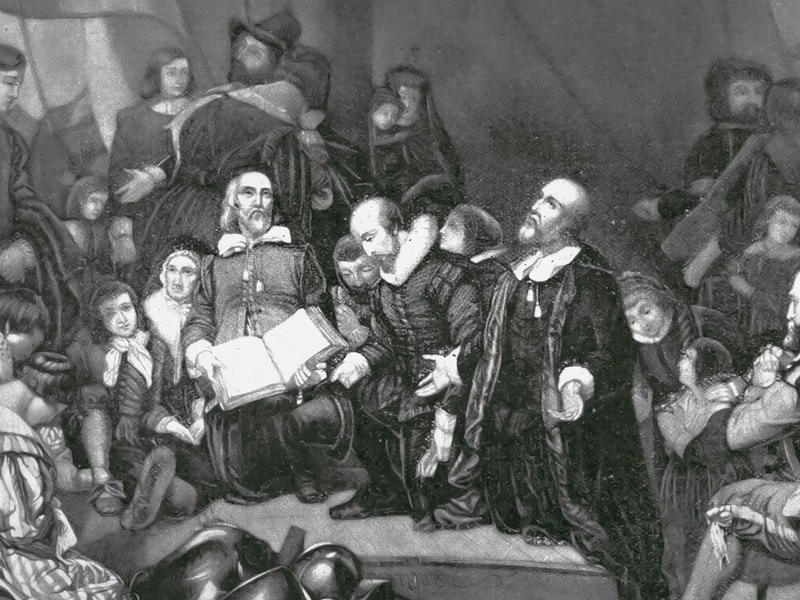
Timon Cline wrote recently that “theonomists” didn’t run Puritan New England. 1 He is correct, in his major thesis, that the claim that “Puritanism and the natural law tradition are antithetical” is “wildly ahistorical.” Mr. Cline demonstrates that Puritans repeatedly extolled natural law. Besides the Puritan sources Mr. Cline mustered,…

by John CarpenterAugust 9, 2022

screen-shot-2022-08-04-at-9-36-57-am
Mark

The Land of the Walking Trees

The Church is the land of the walking trees. In Mark’s Gospel, the identity of Jesus is slowly and progressively revealed. Though St. Mark announces at the beginning of his narrative that Jesus Christ is “the Son of God” (1:1), this is a reality that must be spoon-fed to His…

by Jackson ShepardAugust 4, 2022
11982-sparrowstockephesians
Ephesians

The Significance of Ephesians (with a comparison to Romans)

All Scripture is of ultimate significance as the word of God, but it may be helpful to think about what makes a book (in this case, a letter) possibly unique within the canon. In this case, the “general” nature of Ephesians should stand out, but it often is not recognized…

by Mark HorneAugust 2, 2022
davide-ragusa-g32g_ibprfa-unsplash
Ecclesiastes

A Time to Kill (Ecclesiastes 3:3)

Where do we draw the lines between what is right and wrong? This question is fundamental to civilization, fundamental to a free society. To put this question in the bluntest and most offense terms: if there is a time to kill — which Solomon says there is — whom shall…

by Ralph Allan SmithJuly 28, 2022
screen-shot-2018-04-12-at-9-48-08-am
Biblical Horizons

Broadening Our View of the Trinity

This article was originally posted in May of 1994. We speak of God as Father, Son, and Holy Spirit. The early Church tended to speak of Him as Father, Word, and Spirit. In this short essay, I want to suggest some other ways to think of the Trinity, ways that…

by James B. JordanJuly 26, 2022
jonahwhale-1552x900
Jonah

Journeying Prophets in Kings

Jonah’s Home The story of JONAH belongs in the book of KINGS. JONAH balances the story of the unnamed Judean prophet (1K13) in KINGS’ literary structure. Each story describes a journeying prophet that crosses land or sea to confront a wayward king. The two stories are located during the reigns…

by Scott FairbanksJuly 21, 2022

Showing page 41 of 309

See all
See all
History

Jewish/Non-Jewish Gnosis

In his history of Christianity, August Neander distinguished between gnostics who arose from within Judaism and those whose inspiration came from “Oriental” modes of thought. Here is his description of the Jewish sources of gnosticism: In the following respect, all these Gnostics agree ; they all held . . .…

December 21, 2007
History

Gnosticism and Samaritan theology

A few scattered notes from Jarl Fossum’s book examining the links between the figure of the “angel of Yahweh” in Samaritan theology and the “demiurge” of gnosticism. 1) Fossum points out that Simon Magus, legendarily the fountain of Gnosticism, venerated the Torah, and that some of the church Fathers said…

December 21, 2007
History

Gnosticism and Jewish Revolt

In a 2006 book on the origins of gnosticism, Carl B. Smith offers an alternative account of the connections of Judaism and gnosticism. According to the JETS reviewer: Smith “proposes that gnosticism arose in a social context of ‘alienated Judaism’ influenced by Greco-Roman and early Christian ideas in the aftermath…

December 21, 2007

Gnosticism and AD 70

In a book published in 1959, R. M. Grant attempted “to explain Gnosticism as arising out of the debris of apocalyptic-eschatological hopes which resulted from the fall or falls of Jerusalem.” According to a reviewer in Theology T0day , “Grant stresses the Jewish element which, as he rightly says, has…

December 21, 2007
History

Yahweh/Kronos

Origen says that the Ophite demiurge had the face of a lion and was connected with Saturn, and this has led some scholars to conclude that Jaldabaoth was a combination of Baal and Kronos. John of Damascus says that the Phoenicians held Kronos to be a kind of demiurge, and…

December 21, 2007
History

Jaldabaoth

According to Alfred Honig (writing in the late 19th century), the Ophite name for the demiurge, Jaldabaoth, comes from a Hebrew phrase meaning “child of chaos,” and the etymology goes back at least to the 1820s. Scholem argued, however, that the name was invented by a Jew and is a…

December 21, 2007

Showing page 1592 of 2212

Browse by Category

In Medias Res

Your weekly digest for all things Theopolis.

Donate

Theopolis is nearly 100% donor-supported. Consider joining us on our mission.