Theopolis Logo

Writing

Explore our collection of theological essays, biblical studies, and reflections on faith and culture.

See all
sculptor
Art

The Artist's Litany

If we say that we have no sin, we deceive ourselves, and the truth is not in us. (1 John 1:8) O God the Father, creator of heaven and earth, Alpha and Omega, beginning and end, who inspired Creation with the breath of your nostrils, who placed Adam in the…

by Christian LeithartFebruary 2, 2016
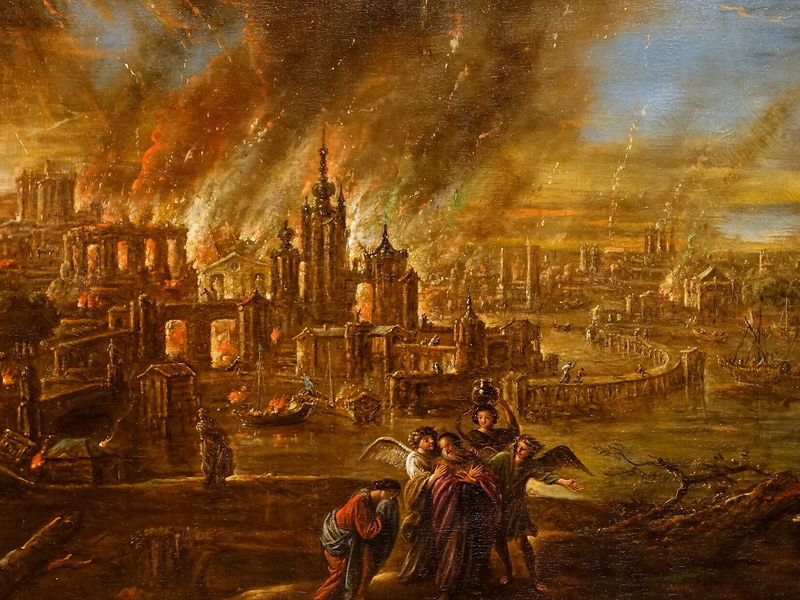
sodom_and_gomorrah_afire_by_jacob_jacobsz-_de_wet_d-_j-_probably_koln_c-_1680_oil_on_canvas_-_hessisches_landesmuseum_darmstadt_-_darmstadt_germany_-_dsc01149-e1632540497247
American Culture

American Sodom

For nearly a half-century, Sodom has been a key symbol in the American culture wars. On the one side, we have an aggressive movement among homosexuals that has first decriminalized homosexual conduct, then to force cultural and legal recognition of homosexuals as a minority and to normalize homosexual behaviors, finally…

by Peter LeithartJanuary 28, 2016
image-20150409-15244-1r08rsu
Biblical Theology

The Meaning of the Mount of Olives

Speaking of the Church, Romans 11:16-17 says, "And if the root be holy, the branches are also. But if some of the branches were broken off, and you, being a wild olive were grafted in among them and became partaker with them of the root of the fatness of the…

by James B. JordanJanuary 26, 2016
img_6134
Isaiah

No Sabbath for God

At the end of Isaiah 61, Yahweh's Servant rejoices because the Lord clothes Him with salvation and righteousness. He decks Him like a bridegroom with a garland on His head. He wears jewels like a bride. He is a new bridegroom in a new garden of Eden, a garden of…

by Peter LeithartJanuary 21, 2016
hebrew-manuscript-2
Biblical Law

Approaching the Torah

Before anything else, a word about “Torah” may be in order. I have been persuaded that “law” is a bad translation of “Torah,” even though it is evident that what is called “Torah” does have commandments, statutes, and ordinances in abundance. Why not “law?” “Law” as a translation for “Torah”…

by Ralph Allan SmithJanuary 19, 2016
jane-austen-2
Biblical Horizons

Jane Austen, Pundit

Few novelists seem as innocent of the temptation to punditry as Jane Austen. Though living through a period that witnessed the birth of an independent United States, the French Revolution and the Terror, the Napoleonic wars and the rise of revolutionary romanticism, and the upheavals of the Industrial Revolution, she…

by Peter LeithartJanuary 14, 2016

Showing page 137 of 309

See all
See all

Conveniens

Bauerschmidt notes that Aquinas frequently argues, especially when speaking of the incarnation, not for “proof” of doctrine but for its “fittingness.” Reason has the role of “manifesting how [the incarnation] fits together (convenire means literally ‘to come together’) with other things that Christians hold true about God.” Perhaps this can…

March 23, 2006

Extra-Augustinisticum

In Epistle 137, Augustine writes: “The Christian teaching nowhere holds that God was so poured into human flesh as either to desert or lose - or to transfer and, as it were, compress within this frail body - the care of governing the universe. This is the thought of people…

March 23, 2006

Thomas on Merit

Commenting on ST I-II, q. 109, Frederick Bauerschmidt says that Thomas uses the word “merit” analogically when we speak of God rewarding human action “since we can act in the first place only because God has given us the capacity to act.” This applies even to Jesus: “even when Thomas…

March 23, 2006

On Seneca, de Beneficiis, Books 1-2

Seneca suggests that ingratitude is the worst of vices, and nothing is more “harmful to society” than ingratitude (I.1). Later in Book I, he lists a series of moral ills that plague society – “homicides, tyrants, thieves, adulterers, ravishers, sacrilegious, traitors” – but concludes that “worse than all these is…

March 23, 2006
Literature

Prospero the Magus

I am grateful to Ralph Smith for references to Frances Yates’ work on Shakespeare’s plays. In an analysis of The Tempest, Frances Yates writes: “It is inevitable and unavoidable in thinking of Prospero to bring in the name of John Dee, the great mathematical magus of whom Shakespeare must have…

March 22, 2006
History

Elizabethan Magic

Educated Elizabethans lived in a world of similitudes. As EMW Tillyard argued, the Elizabethan world picture was constituted by a series of analogous chains of being. The social world manifested and was manifested by the natural world; the universe as a whole resembled human beings; there was a hierarchy among…

March 22, 2006

Showing page 1867 of 2212

Browse by Category

In Medias Res

Your weekly digest for all things Theopolis.

Donate

Theopolis is nearly 100% donor-supported. Consider joining us on our mission.