Theopolis Logo

Writing

Explore our collection of theological essays, biblical studies, and reflections on faith and culture.

See all
blocks-t3mkjxfdims-unsplash-2
Advent

Advent and Christmas Music Recommendations

Inspired by our recent podcast on Christmas and Advent music recommendations, we offer here a list of excellent recordings that are sure to enrich your Advent and Christmas season. Praetorius: Mass for Christmas Morning Paul McCreesh with the Gabrieli Consort and Players Amazon | Spotify | Apple Music 2. Christmas…

by John Ahern and Paul BuckleyDecember 23, 2020

sasha-stories-c6g-26myd34-unsplash
Advent

Between the Altar and the City: Isaiah 65:17-25

In the year 1483 in the city of Nuremberg, the leaders of the renowned Saint Lawrence Church were seeking to redesign their altar, and above the table where the priests presided over the eucharist, they wanted new art installed above the prestigious Krell altar. What they decided on took everyone…

by Casey BedellDecember 22, 2020
adam-and-eve-in-the-garden-of-eden-wenzel-peter
Advent

Why We're the Real Seventh Day Adventists

The consequences of disobedience start with exile from the garden of God and the Tree of Yahweh, but they do not end there. They cascade down through the structure of the dynastic order. Everything which had previously been given in the Kingdom of Elohim is either taken back or curtailed…

by Jerry BowyerDecember 18, 2020
herrmann-stamm-19il-6uc5c4-unsplash
Biblical Studies

Psalm 23: A Lesson in Reading Biblical Poetry

Parallelism: A Course Correction If you have ever studied Hebrew poetry, you have probably heard its basic poetic feature described as “parallelism.” Hebrew poetry is not metered, it does not rhyme, it does not employ many of the common poetical tropes, but its distinctive (and almost universal) feature is commonly…

by Ryan HandermannDecember 15, 2020
screen-shot-2020-12-11-at-10-04-32-am
Deuteronomy

Deuteronomy 17 and the Separation of Powers

In The Crown and the Courts , David C. Flatto traces the development of the idea of judicial independence in Jewish commentaries on the Scriptures – particularly Deuteronomy 17 – from the Second Temple and early rabbinic periods. These periods roughly span 400 BC to 300 AD. Flatto does not…

by James R. RogersDecember 11, 2020
67201-zechariah-verses-1200w-tn
Advent

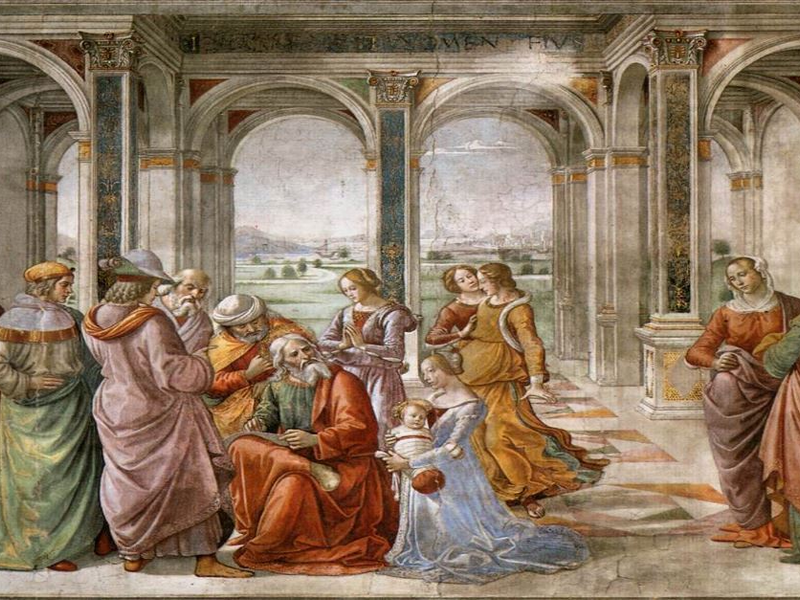
Zechariah and John: A Story in Names

A curious feature of the Infancy Narratives in the Gospel of Luke is the naming of John the Baptist. When the angel appears to Zechariah, he is instructed to give his promised son the name John (Luke 1:13). On the day of John’s circumcision, Luke tells us that “they [presumably…

by Rhys LavertyDecember 8, 2020

Showing page 60 of 309

See all
See all

Conveniens

Bauerschmidt notes that Aquinas frequently argues, especially when speaking of the incarnation, not for “proof” of doctrine but for its “fittingness.” Reason has the role of “manifesting how [the incarnation] fits together (convenire means literally ‘to come together’) with other things that Christians hold true about God.” Perhaps this can…

March 23, 2006

Extra-Augustinisticum

In Epistle 137, Augustine writes: “The Christian teaching nowhere holds that God was so poured into human flesh as either to desert or lose - or to transfer and, as it were, compress within this frail body - the care of governing the universe. This is the thought of people…

March 23, 2006

Thomas on Merit

Commenting on ST I-II, q. 109, Frederick Bauerschmidt says that Thomas uses the word “merit” analogically when we speak of God rewarding human action “since we can act in the first place only because God has given us the capacity to act.” This applies even to Jesus: “even when Thomas…

March 23, 2006

On Seneca, de Beneficiis, Books 1-2

Seneca suggests that ingratitude is the worst of vices, and nothing is more “harmful to society” than ingratitude (I.1). Later in Book I, he lists a series of moral ills that plague society – “homicides, tyrants, thieves, adulterers, ravishers, sacrilegious, traitors” – but concludes that “worse than all these is…

March 23, 2006
Literature

Prospero the Magus

I am grateful to Ralph Smith for references to Frances Yates’ work on Shakespeare’s plays. In an analysis of The Tempest, Frances Yates writes: “It is inevitable and unavoidable in thinking of Prospero to bring in the name of John Dee, the great mathematical magus of whom Shakespeare must have…

March 22, 2006
History

Elizabethan Magic

Educated Elizabethans lived in a world of similitudes. As EMW Tillyard argued, the Elizabethan world picture was constituted by a series of analogous chains of being. The social world manifested and was manifested by the natural world; the universe as a whole resembled human beings; there was a hierarchy among…

March 22, 2006

Showing page 1867 of 2212

Browse by Category

In Medias Res

Your weekly digest for all things Theopolis.

Donate

Theopolis is nearly 100% donor-supported. Consider joining us on our mission.