Theopolis Logo

Writing

Explore our collection of theological essays, biblical studies, and reflections on faith and culture.

See all
little-girl
Children

Honor God With Your Body

I am making a new rule in our house! We are actually kind of skimpy on the house rules. I try very hard to keep things simple: love God, love others, be joyful. It’s not complicated to avoid discipline here. But I have found myself repeating this new rule over…

by Lindsey TollefsonApril 9, 2015

giotto-noli-me-3
John

The Gardener and the Beloved, (Part 3)

Click HERE for Part 2 The voice of Jesus transforms and changes Mary when she hears him speak her name. This is her last “turning.” So also the woman in the Song of Songs longs to hear the voice of her beloved. Let me see your face, let me hear…

by Jeff MeyersApril 6, 2015
giotto-noli-me-2
John

The Gardener and the Beloved, (Part 2)

Click HERE for Part 1. The details of this story call the attentive reader back to the drama of Solomon’s Song of Songs. And the Song of Song’s alludes to, ties us into the story of Adam and Eve in the Garden and the promise of a coming Messiah that…

by Jeff MeyersApril 4, 2015
easter-term-2015-2
Theopolis News

Easter Term, 2015

“The course was a paradigm shift for me,” said Jonathan Sedlak, a Milwaukee electrical contractor who attended Theopolis’s course on Revelation. “I am left with a book that is far more practical than it has ever seemed before.” Jonathan Anderson of Louisville, Kentucky found the course “refreshing.” “I finished with…

by TheopolisApril 2, 2015
psalm-singing
Genesis

Worship as Response: Liturgical Logic, (Part 1)

“It is only by participation in a rational, practice-based community that one becomes rational.” – Alasdair MacIntyre It may be perfectly clear to a chef why adding unsifted powdered sugar to a hot frosting is a bad idea. But for an amateur cook, this may be the kind of rule…

by Jonathan BarlowApril 2, 2015
giotto-noli-me
John

The Gardener and the Beloved, (Part 1)

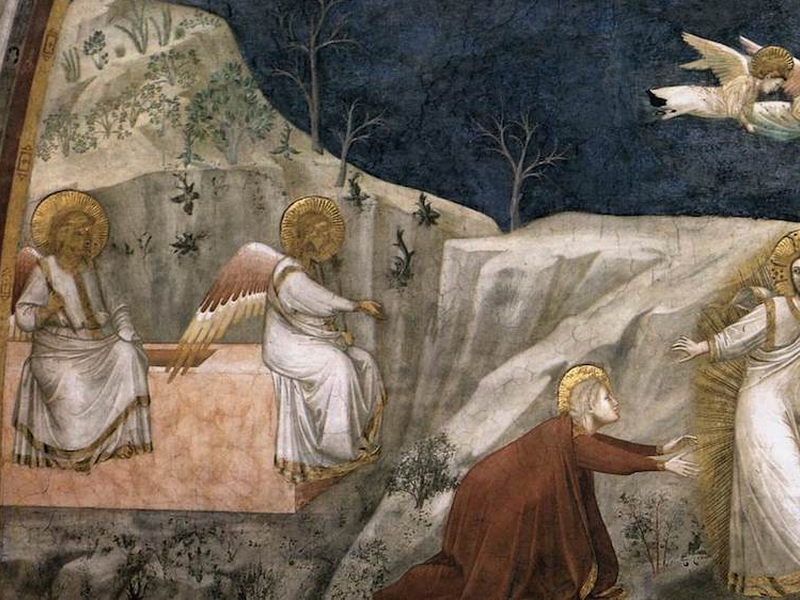
On a fresco in a chapel in Padua, Italy, there is a famous painting depicting the dramatic post-resurrection scene in John 20 with Mary and Jesus outside of the garden tomb. Giotto di Bondone painted it in the early 14th century. Jesus is striding from the tomb with a victor’s…

by Jeff MeyersApril 1, 2015

Showing page 156 of 309

See all
See all
Uncategorized

Civilizing Process

In a 1983 article in Past & Present , Lawrence Stone presented evidence that showed a precipitous drop in the homicide rate in England from the 14th to the 20th century. Why? Stone thinks that Elias’s Civilizing Process had something to do with it: “Yves Castan has shown with great…

March 30, 2013
Uncategorized

Critique of Violence

Critchley ( Philosophy and the Return of Violence: Studies from this Widening Gyre , 64- 8) gives a lucid analysis of Walter Benjamin’s “Critique of Violence” (in Reflections: Essays, Aphorisms, Autobiographical Writings ), organized around Benjamin’s distinctions between law-making and law-preserving violence, between political and the general strike, and between…

March 30, 2013
Uncategorized

Zizek’s dreams

In his essay in Philosophy and the Return of Violence: Studies from this Widening Gyre , Simon Critchley describes Zizek’s Barlebyan politics in Shakespearean terms: “Zizek is, I think, a Slovenian Hamlet.” He “dreams of a divine violence, a cataclysmic, purifying violence of the sovereign ethical deed,” but is left…

March 30, 2013
Politics

Shades of Grey

At the end of his massively documented The Shadow World: Inside the Global Arms Trade , Andrew Feinstein notes the blurring of lines between formal and informal arms markets, the black and the white markets that merge into gray: “While the large defence contractors like BAE and Lockheed Martin -…

March 29, 2013
Uncategorized

Permanent War Economy

Back in 1944, Walter Oakes predicted Marxianly that late capitalism would naturally develop a “permanent war economy.” Defining a war economy as one where “the government’s expenditures for war . . . become a legitimate and significant end-purpose of economic activity.” Capitalism, Oakes claimed, seeks equilibrium that reduces unemployment and…

March 29, 2013
Politics

Not Bees

Some political theorists have thought that we can live like bees - sociable without command, law, speech, punishments. Hobbes demurs ( Hobbes: Leviathan , II.17). And not because we are superior to bees. We can’t live like bees because we are “continually in competition for honour and Dignity” and thus…

March 29, 2013

Showing page 763 of 2212

Browse by Category

In Medias Res

Your weekly digest for all things Theopolis.

Donate

Theopolis is nearly 100% donor-supported. Consider joining us on our mission.