Theopolis Logo

Writing

Explore our collection of theological essays, biblical studies, and reflections on faith and culture.

See all
actionvance-t7el2ig3jmc-unsplash
Esther

Genesis 1 and Genesis 8

I mentioned last month ( BH 82) in my essay "Like a Dove" that Genesis 8 is a recapitulation of Genesis 1. Let me explicate that assertion here. Of course, the world after the Flood is a new creation, so we may expect a recapitulation of the first creation. It…

by James B. JordanMarch 28, 1996

ben-white-w8qqn1pmqh0-unsplash
Daniel

Esther: Historical & Chronological Comments (I)

The book of Esther is one of the most neglected of the books of the Bible. To be sure, sermons are preached on it, and commentaries have occasionally been written on it, but almost without exception Esther has been interpreted in isolation from the rest of Biblical history, chronology, and…

by James B. JordanMarch 28, 1996

actionvance-t7el2ig3jmc-unsplash
Biblical Horizons

A Letter on Geocentricity

Dear Mr. ______, . . . Here is how I look at the geocentricity question. Since I don’t recall what I wrote you before, I may be repeating some things. 1. The Bible does not teach it. Biblical passages used to support the idea are being misinterpreted. My original paper…

by James B. JordanMarch 28, 1996

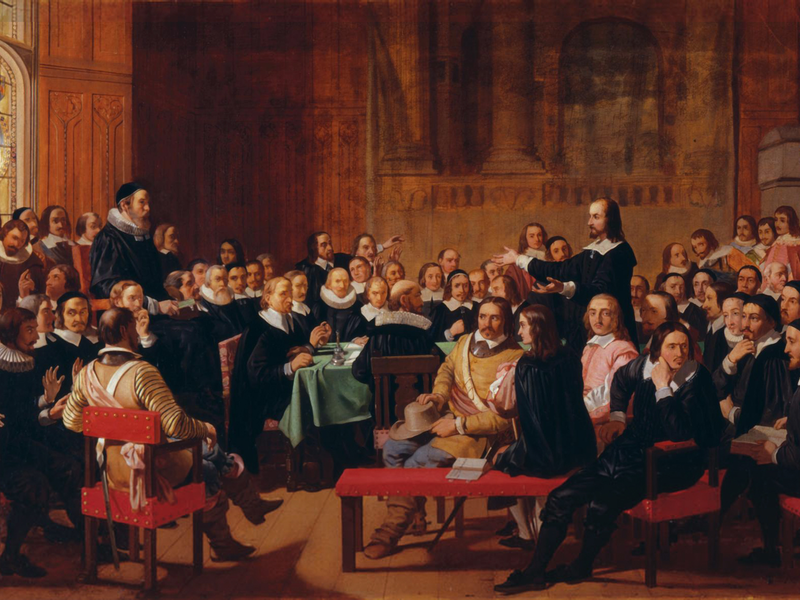
assertion_of_liberty_of_conscience_by_the_independents_of_the_westminster_assembly_of_divines_1644
Biblical Horizons

What is God?

Answer 4 of the Westminster Shorter Catechism is often taken as a magnificent answer to the question, "What is God?" It reads: "God is a Spirit, infinite, eternal, and unchangeable in his being, wisdom, power, holiness, justice, goodness, and truth." Presbyterians are fond of praising this statement, preaching on it,…

by James B. JordanFebruary 28, 1996
screenshot-2023-08-28-at-4-42-36-pm
Baptism

Like a Dove

The gospels tell us that at Jesus’ baptism, the Holy Spirit descended upon Him "in bodily form like a dove" (Luke 3:22 & parallels). Biblically sensitive commentators have associated this event with three Old Testament parallels: (1) the hovering of the Spirit over the creation in Genesis 1:2; (2) the…

by James B. JordanFebruary 28, 1996
tim-wildsmith-gzggi42wggm-unsplash
John

Jesus at Belshazzar’s Feast: Being an Explanatory Disquisition on an Aspect of the Story of the Woman Taken in Adultery

This they said to test him, that they might have some charge to bring against him. Jesus bent down and wrote with his finger on the ground. (John 8:6) The story of the woman taken in adultery (John 7:53-8:11) has been part of the canonical Christian Bible from its earliest…

by James B. JordanFebruary 28, 1996

Showing page 267 of 309

See all

Showing page 34 of 43

See all

Conveniens

Bauerschmidt notes that Aquinas frequently argues, especially when speaking of the incarnation, not for “proof” of doctrine but for its “fittingness.” Reason has the role of “manifesting how [the incarnation] fits together (convenire means literally ‘to come together’) with other things that Christians hold true about God.” Perhaps this can…

March 23, 2006

Extra-Augustinisticum

In Epistle 137, Augustine writes: “The Christian teaching nowhere holds that God was so poured into human flesh as either to desert or lose - or to transfer and, as it were, compress within this frail body - the care of governing the universe. This is the thought of people…

March 23, 2006

Thomas on Merit

Commenting on ST I-II, q. 109, Frederick Bauerschmidt says that Thomas uses the word “merit” analogically when we speak of God rewarding human action “since we can act in the first place only because God has given us the capacity to act.” This applies even to Jesus: “even when Thomas…

March 23, 2006

On Seneca, de Beneficiis, Books 1-2

Seneca suggests that ingratitude is the worst of vices, and nothing is more “harmful to society” than ingratitude (I.1). Later in Book I, he lists a series of moral ills that plague society – “homicides, tyrants, thieves, adulterers, ravishers, sacrilegious, traitors” – but concludes that “worse than all these is…

March 23, 2006
Literature

Prospero the Magus

I am grateful to Ralph Smith for references to Frances Yates’ work on Shakespeare’s plays. In an analysis of The Tempest, Frances Yates writes: “It is inevitable and unavoidable in thinking of Prospero to bring in the name of John Dee, the great mathematical magus of whom Shakespeare must have…

March 22, 2006
History

Elizabethan Magic

Educated Elizabethans lived in a world of similitudes. As EMW Tillyard argued, the Elizabethan world picture was constituted by a series of analogous chains of being. The social world manifested and was manifested by the natural world; the universe as a whole resembled human beings; there was a hierarchy among…

March 22, 2006

Showing page 1867 of 2212

Browse by Category

In Medias Res

Your weekly digest for all things Theopolis.

Donate

Theopolis is nearly 100% donor-supported. Consider joining us on our mission.