Theopolis Logo

Writing

Explore our collection of theological essays, biblical studies, and reflections on faith and culture.

See all
actionvance-t7el2ig3jmc-unsplash
Esther

Genesis 1 and Genesis 8

I mentioned last month ( BH 82) in my essay "Like a Dove" that Genesis 8 is a recapitulation of Genesis 1. Let me explicate that assertion here. Of course, the world after the Flood is a new creation, so we may expect a recapitulation of the first creation. It…

by James B. JordanMarch 28, 1996

ben-white-w8qqn1pmqh0-unsplash
Daniel

Esther: Historical & Chronological Comments (I)

The book of Esther is one of the most neglected of the books of the Bible. To be sure, sermons are preached on it, and commentaries have occasionally been written on it, but almost without exception Esther has been interpreted in isolation from the rest of Biblical history, chronology, and…

by James B. JordanMarch 28, 1996

actionvance-t7el2ig3jmc-unsplash
Biblical Horizons

A Letter on Geocentricity

Dear Mr. ______, . . . Here is how I look at the geocentricity question. Since I don’t recall what I wrote you before, I may be repeating some things. 1. The Bible does not teach it. Biblical passages used to support the idea are being misinterpreted. My original paper…

by James B. JordanMarch 28, 1996
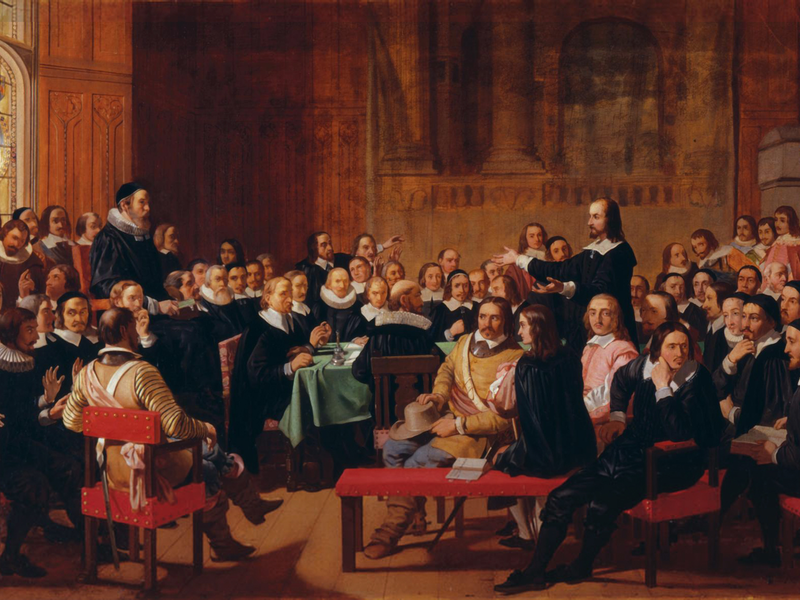
assertion_of_liberty_of_conscience_by_the_independents_of_the_westminster_assembly_of_divines_1644
Biblical Horizons

What is God?

Answer 4 of the Westminster Shorter Catechism is often taken as a magnificent answer to the question, "What is God?" It reads: "God is a Spirit, infinite, eternal, and unchangeable in his being, wisdom, power, holiness, justice, goodness, and truth." Presbyterians are fond of praising this statement, preaching on it,…

by James B. JordanFebruary 28, 1996
screenshot-2023-08-28-at-4-42-36-pm
Baptism

Like a Dove

The gospels tell us that at Jesus’ baptism, the Holy Spirit descended upon Him "in bodily form like a dove" (Luke 3:22 & parallels). Biblically sensitive commentators have associated this event with three Old Testament parallels: (1) the hovering of the Spirit over the creation in Genesis 1:2; (2) the…

by James B. JordanFebruary 28, 1996
tim-wildsmith-gzggi42wggm-unsplash
John

Jesus at Belshazzar’s Feast: Being an Explanatory Disquisition on an Aspect of the Story of the Woman Taken in Adultery

This they said to test him, that they might have some charge to bring against him. Jesus bent down and wrote with his finger on the ground. (John 8:6) The story of the woman taken in adultery (John 7:53-8:11) has been part of the canonical Christian Bible from its earliest…

by James B. JordanFebruary 28, 1996

Showing page 267 of 309

See all
See all
Politics

Machiavelli on Ingratitude

From Book 1 of the Discourses on Livy: FOR WHAT REASONS THE ROMANS WERE LESS UNGRATEFUL TO THEIR CITIZENS THAN THE ATHENIANS Whoever reads of the things done by Republics will find in all of them some species of ingratitude against their citizens, but he will find less in Rome…

March 21, 2006

What Plato Owed Athens

Socrates’ explanation of his willingness to submit to the laws of Athens, from the Crito. Since he owes the city his very existence, he has no right to renounce the laws when they turn against him: Soc. “And was that our agreement with you?” the law would say, “or were…

March 21, 2006
History

Renaissance on ingratitude

A few quotations from Renaissance writers on the subject of ingratitude, drawn from Catherine Dunn’s excellent 1946 CUA dissertation on the subject: Lodowick Bryskett argued that ingratitude was contrary to reason: “How shamefull a thing is it therefore to man, that brute beasts should give him examples of gratitude; and…

March 21, 2006

Persians and ingratitude

Xenophon describes the Persian training of boys in the Cyropaedia (1.2.6-7), highlighting the effects of ingratitude: “The boys go to school and give their time to learning justice and righteousness: they will tell you they come for that purpose, and the phrase is as natural with them as it is…

March 21, 2006

Aristotelian gratitude

Some excerpts from Aristotle’s discussion relevant to gratitude in Nicomachian Ethics. First, a treatment of the reasons for making return on a benefit received (from 9.1): “But who is to fix the worth of the service; he who makes the sacrifice or he who has got the advantage? At any…

March 21, 2006

Parenthood

Katherine Marsh writes in the March 13 TNR that parenthood is not what it was cracked up to be. Instead of bringing fulfillment and happiness, it turns out that parenthood is difficult, and a number of recent articles and studies have suggested that parents are more “sad, distracted or depressed”…

March 14, 2006

Showing page 1869 of 2212

Browse by Category

In Medias Res

Your weekly digest for all things Theopolis.

Donate

Theopolis is nearly 100% donor-supported. Consider joining us on our mission.