Theopolis Logo

Writing

Explore our collection of theological essays, biblical studies, and reflections on faith and culture.

See all
aaron-burden-1ebsmyrau-s-unsplash
Biblical Horizons

An Older Essay on the Gospel Order

I thought it might be good to put this up here, since it is 14 years old, and itself reflects earlier discussion. From this you can see that we at BH have been considering this notion for quite some time. Clearly, the last word has not been said. — James…

by James B. JordanFebruary 14, 2008

aaron-burden-qjdzyt_k8xg-unsplash
Biblical Horizons

Chiasms in James

Hopefully, my commentary on James will be out later this year. But here are a few chiasms for your consideration. I think the James 5 chiasm orginally came from Doug Jordan. The entire book of James is focused on how the pastors and leaders (“brothers”) of the church use their…

by Jeff MeyersFebruary 14, 2008
screenshot-2023-08-30-at-11-50-23-am
Job

Parables | (Part 2)

In my first post I noted that the parables of Jesus were not simply illustrative stories. They are really nothing like the kind of simple, homely illustrations that preachers often use to explain difficult concepts to their congregations. Just to be clear: there’s nothing wrong with illustrating one’s sermonic statements.…

by Jeff MeyersFebruary 14, 2008
skyler-gerald-akljfvj5ym4-unsplash
Ephesians

The Praise Precedes the Indicative

Ephesians is often treated as a pure type example of the Pauline method that “the indicative preceds the imperative.” But what Paul does first is pray . Simply reading verse 3 and following involves readers in a prayer of thanksgiving to God–and much more so for those listening to the…

by Mark HorneFebruary 14, 2008
aaron-burden-qjdzyt_k8xg-unsplash
Luke

"I Came Not to Call the Righteous, but Sinners"

Yesterday, I took part with my oldest son in a church-sponsored city outreach project (not because I’m especially prone to such behavior but because my son has a Boy Scout requirement that this would help him meet). Before we were sent out on our various jobs, the leader gave a…

by Mark HorneFebruary 11, 2008
aaron-burden-1ebsmyrau-s-unsplash
Biblical Studies

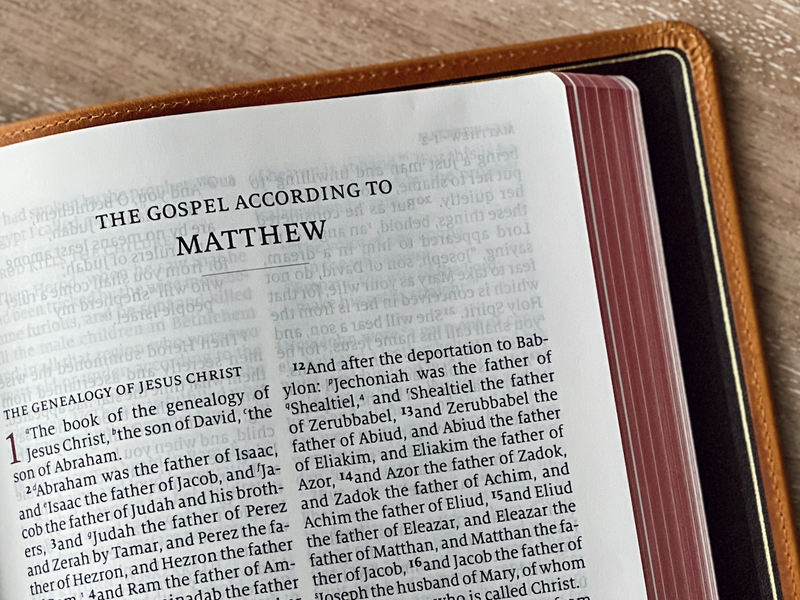
The Sequence of the Four Gospels

There is a scene in Prince Caspian , the second in C. S. Lewis’s Chronicles of Narnia that helps explain why it is we have four Gospels, that is four accounts of the Good News of Jesus Christ—Matthew, Mark, Luke, and John. It is the account of Lucy’s longed-for experience…

by Jeff MeyersFebruary 9, 2008

Showing page 215 of 309

See all
See all

New Face for the World

R owan Williams ( Sign and Sacrifice ) summarizes the Anselmian understanding of the atonement using the categories of sacrifice, obedience, and gift, all set within a Trinitarian frame. It's quite lovely. Citing Hebrews citing Psalm 40, Williams argues that the Old Testament sacrificial system existed to symbolize the true…

February 28, 2017

At the Parbar

D escribing the assignments of Levite gatekeepers, the Chronicler records that there were four at the “highway” at the western end of the temple, and two “at the Parbar,” which was also on the west (1 Chronicles 26:18). Scholars have proposed a variety of foreign etymologies for the term. From…

February 27, 2017
Architecture

How To Read Churches

D enis McNamara's How To Read Churches is an extraordinary book. Subtitled “a crash course in ecclesiastical architecture,” it covers building types, floor plans, sections of churches (nave, apse, choir), materials, windows, altars, ornaments in 256, 6 x 6-inch pages, each of which is stuffed with pictures and diagrams and…

February 24, 2017

Undemocratic Education

J ohn Milbank cites what he calls “Socrates's subversive realization” that “education can never be democratic” ( Being Reconciled , 182). This is in part because “the sheer singular uniqueness and contingency of wisdom is unable to subordinate itself to any majority,” partly because “if one is to learn, one…

February 24, 2017

Irrationality and Intellectual Flaws

T hrough a series of thought experiments, Richard Foley ( Intellectual Trust in Oneself and Others ) develops a concept of rationality as “a matter of making oneself invulnerable to intellectual self-criticism to the extent possible, of living up to one’s own deepest intellectual convictions and standards.” Rationality thus “requires…

February 24, 2017

Lockean Individualism

F ollowing Alvin Platinga, Richard Foley summarizes the principles of Locke's epistemology in three principles ( Intellectual Trust in Oneself and Others ): Evidence (the “obligation to base one's opinion on one's evidence,” the latter defined as “what one knows with certainty”); appraisal (the obligation “to appraise the probability of…

February 24, 2017

Showing page 202 of 2212

Browse by Category

In Medias Res

Your weekly digest for all things Theopolis.

Donate

Theopolis is nearly 100% donor-supported. Consider joining us on our mission.