Theopolis Logo

Writing

Explore our collection of theological essays, biblical studies, and reflections on faith and culture.

See all
aaron-burden-1ebsmyrau-s-unsplash
Biblical Horizons

An Older Essay on the Gospel Order

I thought it might be good to put this up here, since it is 14 years old, and itself reflects earlier discussion. From this you can see that we at BH have been considering this notion for quite some time. Clearly, the last word has not been said. — James…

by James B. JordanFebruary 14, 2008

aaron-burden-qjdzyt_k8xg-unsplash
Biblical Horizons

Chiasms in James

Hopefully, my commentary on James will be out later this year. But here are a few chiasms for your consideration. I think the James 5 chiasm orginally came from Doug Jordan. The entire book of James is focused on how the pastors and leaders (“brothers”) of the church use their…

by Jeff MeyersFebruary 14, 2008
screenshot-2023-08-30-at-11-50-23-am
Job

Parables | (Part 2)

In my first post I noted that the parables of Jesus were not simply illustrative stories. They are really nothing like the kind of simple, homely illustrations that preachers often use to explain difficult concepts to their congregations. Just to be clear: there’s nothing wrong with illustrating one’s sermonic statements.…

by Jeff MeyersFebruary 14, 2008
skyler-gerald-akljfvj5ym4-unsplash
Ephesians

The Praise Precedes the Indicative

Ephesians is often treated as a pure type example of the Pauline method that “the indicative preceds the imperative.” But what Paul does first is pray . Simply reading verse 3 and following involves readers in a prayer of thanksgiving to God–and much more so for those listening to the…

by Mark HorneFebruary 14, 2008
aaron-burden-qjdzyt_k8xg-unsplash
Luke

"I Came Not to Call the Righteous, but Sinners"

Yesterday, I took part with my oldest son in a church-sponsored city outreach project (not because I’m especially prone to such behavior but because my son has a Boy Scout requirement that this would help him meet). Before we were sent out on our various jobs, the leader gave a…

by Mark HorneFebruary 11, 2008
aaron-burden-1ebsmyrau-s-unsplash
Biblical Studies

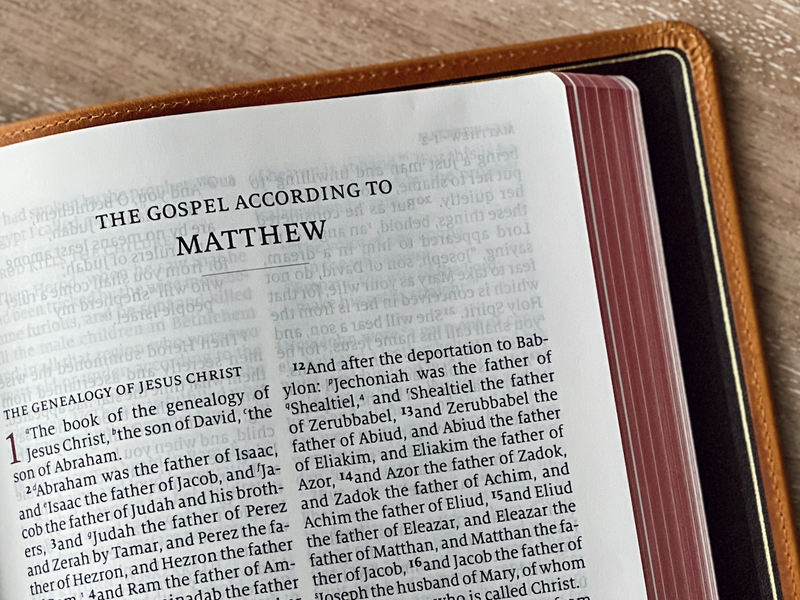
The Sequence of the Four Gospels

There is a scene in Prince Caspian , the second in C. S. Lewis’s Chronicles of Narnia that helps explain why it is we have four Gospels, that is four accounts of the Good News of Jesus Christ—Matthew, Mark, Luke, and John. It is the account of Lucy’s longed-for experience…

by Jeff MeyersFebruary 9, 2008

Showing page 215 of 309

See all

Showing page 6 of 43

See all
Literature

Michel on Tragedy

Laurence Michel, exploring the “Possibility of a Christian Tragedy,” suggests that the creation account of Genesis opens the possibility for a “tragic sense of life.” How? “To have a world imitative of the simple perfection of God one must have multiplicity and diversity of goods. Various evils and contraries will…

January 15, 2004
Theology

Evil and Good

CS Lewis says in Pilgrim’s Regress : “Evil is fissiparous, and could never in a thousand eternities find any way to arrest its own reproduction. If it could, it could be no longer evil: for Form and Limit belong to the good.” But what then of a Good and Infinite…

January 15, 2004
Literature

Niebuhr on Christianity and Tragedy

In a chapter in Beyond Tragedy , Reinhold Niebuhr considers the relationship between Christianity and tragedy. He denies that Christianity is tragic: “The cross is not tragic but the resolution of tragedy.” In the course of his discussion he makes several intriguing points about the tragic outlook: 1) He highlights…

January 15, 2004
Literature

Weil on Tragedy

Simone Weil offered one of the most thorough-going Christian defenses of tragedy, though that defense comes at considerable cost to her orthodoxy. As Katherine Brueck points out in her study of Weil’s theory ( The Redemption of Tragedy ), Weil recognized that what was at stake in a discussion of…

January 15, 2004

More Thoughts from Segal

Some more thoughts from Segal’s book: 1) He points out the optimism that gripped Athens in the Periclean period, an optimism about the ability of human LOGOS and NOMOS to stave off the savage potential of man’s PHUSIS. But that was short-lived: The Peloponnesian wars broke out, marked by several…

January 15, 2004

civilization in Sophocles

In his study of Sophocles, Tragedy and Civilization , Charles Segal points to several Greek terms that might be translated as “civilization” and that capture various aspects of civilized life: NOMOS = the established institutions, customs, and norms of a people POLITEIA = the form of government, especially the constitutional…

January 15, 2004

Showing page 2136 of 2212

Browse by Category

In Medias Res

Your weekly digest for all things Theopolis.

Donate

Theopolis is nearly 100% donor-supported. Consider joining us on our mission.