Theopolis Logo

Writing

Explore our collection of theological essays, biblical studies, and reflections on faith and culture.

See all
actionvance-t7el2ig3jmc-unsplash
Esther

Genesis 1 and Genesis 8

I mentioned last month ( BH 82) in my essay "Like a Dove" that Genesis 8 is a recapitulation of Genesis 1. Let me explicate that assertion here. Of course, the world after the Flood is a new creation, so we may expect a recapitulation of the first creation. It…

by James B. JordanMarch 28, 1996

ben-white-w8qqn1pmqh0-unsplash
Daniel

Esther: Historical & Chronological Comments (I)

The book of Esther is one of the most neglected of the books of the Bible. To be sure, sermons are preached on it, and commentaries have occasionally been written on it, but almost without exception Esther has been interpreted in isolation from the rest of Biblical history, chronology, and…

by James B. JordanMarch 28, 1996

actionvance-t7el2ig3jmc-unsplash
Biblical Horizons

A Letter on Geocentricity

Dear Mr. ______, . . . Here is how I look at the geocentricity question. Since I don’t recall what I wrote you before, I may be repeating some things. 1. The Bible does not teach it. Biblical passages used to support the idea are being misinterpreted. My original paper…

by James B. JordanMarch 28, 1996

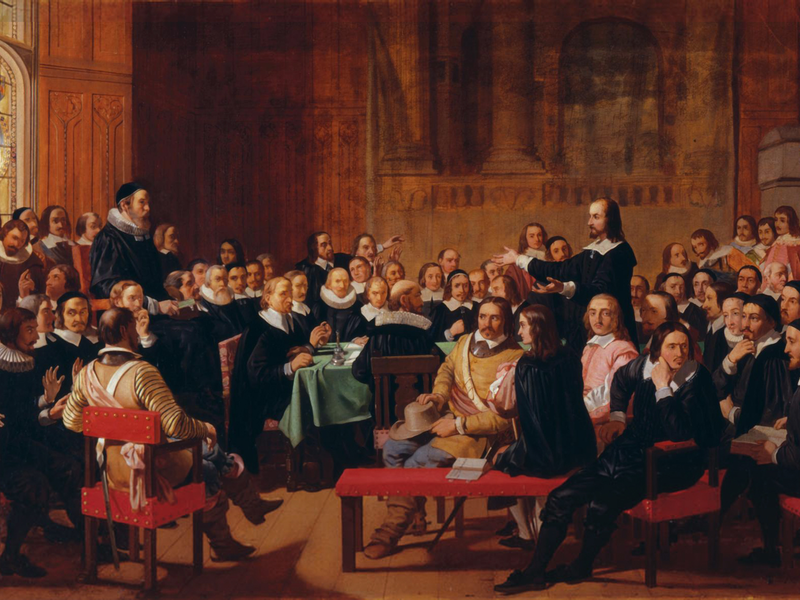
assertion_of_liberty_of_conscience_by_the_independents_of_the_westminster_assembly_of_divines_1644
Biblical Horizons

What is God?

Answer 4 of the Westminster Shorter Catechism is often taken as a magnificent answer to the question, "What is God?" It reads: "God is a Spirit, infinite, eternal, and unchangeable in his being, wisdom, power, holiness, justice, goodness, and truth." Presbyterians are fond of praising this statement, preaching on it,…

by James B. JordanFebruary 28, 1996
screenshot-2023-08-28-at-4-42-36-pm
Baptism

Like a Dove

The gospels tell us that at Jesus’ baptism, the Holy Spirit descended upon Him "in bodily form like a dove" (Luke 3:22 & parallels). Biblically sensitive commentators have associated this event with three Old Testament parallels: (1) the hovering of the Spirit over the creation in Genesis 1:2; (2) the…

by James B. JordanFebruary 28, 1996
tim-wildsmith-gzggi42wggm-unsplash
John

Jesus at Belshazzar’s Feast: Being an Explanatory Disquisition on an Aspect of the Story of the Woman Taken in Adultery

This they said to test him, that they might have some charge to bring against him. Jesus bent down and wrote with his finger on the ground. (John 8:6) The story of the woman taken in adultery (John 7:53-8:11) has been part of the canonical Christian Bible from its earliest…

by James B. JordanFebruary 28, 1996

Showing page 267 of 309

See all
See all
Literature

Seneca’s failure

Wallace again on Timon of Athens . Wallace argues that Shakespeare has written a play to explore Seneca’s society of benefits and gratitude, and shows that the classical model of social order is impossible: “the cast would appear to have been designed to test the Senecan hypothesis about the nature…

November 1, 2007
Philosophy

Elizabethan Seneca

Wallace again on Seneca in Shakespeare: “The first separat e publication of De Benficiis in an English translation was Nicholas Haward’s The Line of Liberalitie in 1569, which included only the first three books, but William Baldwin’s popular Treatise of Morall Philosophie had appeared in 1547 and contained one chapter…

November 1, 2007
Literature

Senecan Shakespeare

In a 1986 article in Modern Philology , John Wallace argues that Timon of Athens is “Shakespeare’s Senecan Study,” reflecting on the issues raised by Seneca’s de Beneficiis : “Shakespeare must have been thinking of Seneca, but a safer argument could have been constructed on the premise that Shakespeare was…

November 1, 2007
Literature

Roman trilogy

Paul Cantor describes three of Shakespeare’s Roman plays as a trilogy, moving from the Republic ( Coriolanus ) to the early empire ( Julius Caesar ) to the decadence of Octavian ( Antony and Cleopatra ). Together they form “a kind of historical trilogy, dramatizing the rise and fall of…

November 1, 2007

Fat, Body Parts, Liver Lobes

In her Leviticus as Literature , the late Mary Douglas offers some interesting possibilities for interpreting the prohibition of eating fat and for the arrangement of animal portions on the altar. Her interpretation is guided by her recognition of analogies between Sinai, the tabernacle, and the body, both of the…

November 1, 2007

Showing page 1612 of 2212

Browse by Category

In Medias Res

Your weekly digest for all things Theopolis.

Donate

Theopolis is nearly 100% donor-supported. Consider joining us on our mission.